How to Win a War Without Firing a Shot
The economics of modern warfare — from Soviet tank production to the US-China tariff war
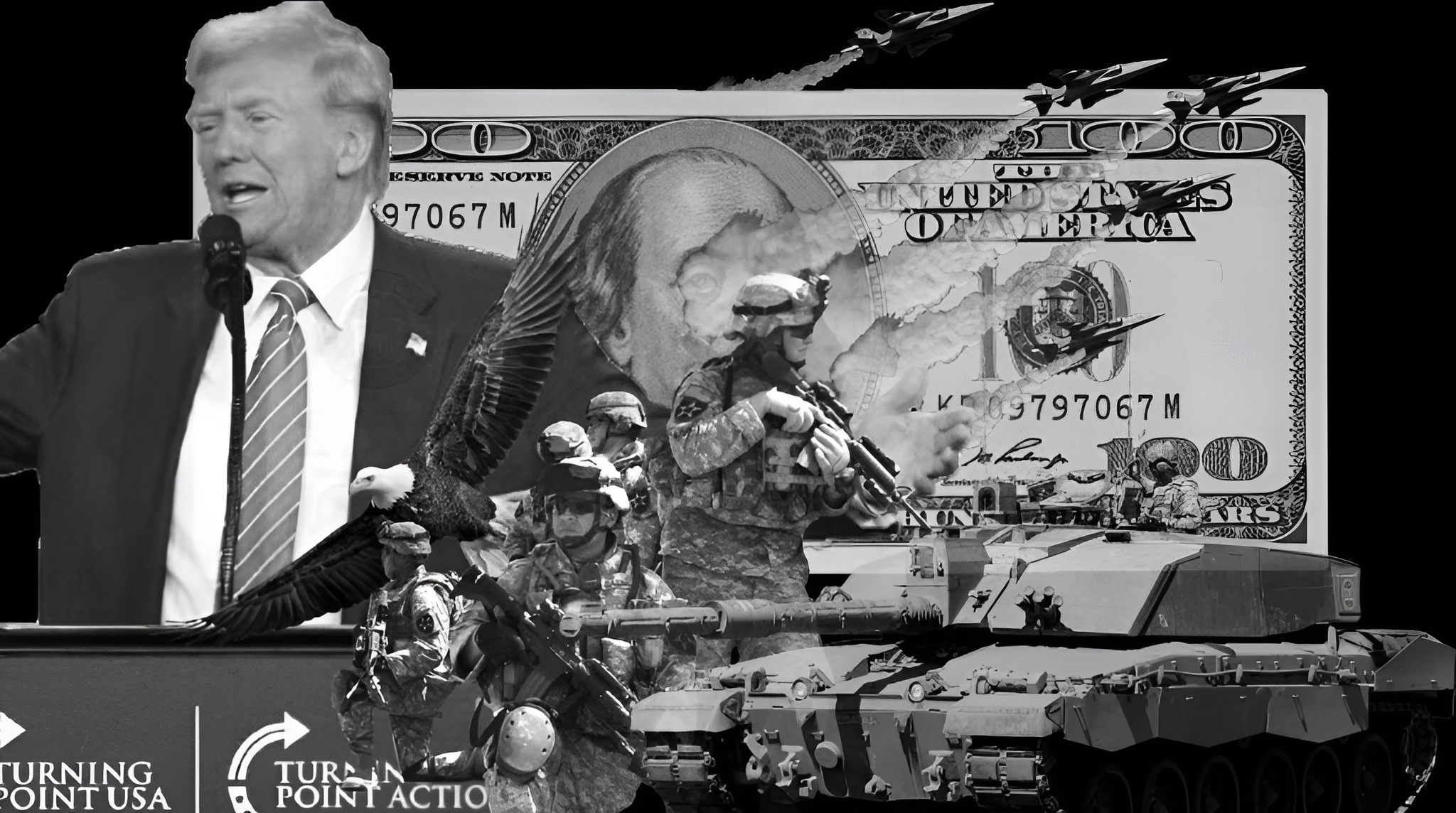
With world leaders stirring the pot, conflicts have been brewing non-stop since the dawn of the 21st century. And economics? It's not watching from the sidelines — it's the invisible weapon.
The Russian invasion of Ukraine has exposed something — an unseen secret about modern warfare: the most powerful armies in the world are running out of ammunition.1 Not because they misuse ammunition, but because the global economy was never designed to sustain this kind of conflict.
This is the hidden constraint of 21st century warfare. Weapons have become so technologically sophisticated that they are extraordinarily difficult to replace. A Challenger 2 tank is not a piece of industrial machinery that can be stamped out of metal sheets on a production line. It is a tool of precision that requires rounds made from depleted uranium, thermal imaging, composite reactive armour, and networks of supply chains that span across dozens of specialist manufacturers.
The same complexity is found in the air and at sea. Modern missile systems used by both navies and air forces can strike targets hundreds of kilometres away with pinpoint accuracy, but each launch costs hundreds of thousands of pounds — sometimes millions — and takes months to replace.2 Sustained use requires years of massive stockpiles — Iran, for instance, has been accumulating for up to two decades. Each launch represents a significant financial decision, not just a military one.
During World War II, this wasn't a problem.
During World War II, this wasn't a problem. Soviet factories were quite literally relocated and converted to tank production overnight, producing T-34s faster than they could be destroyed.3 Today that elastic industry is gone. Modern specialised robotics and complex logistics have an increasingly inelastic price elasticity of supply — they cannot be scaled up and switched on in a matter of moments when a crisis begins.
This is where economics enters the warzone. The side that wins a modern conflict is not the side with the best weapons — it's the side with the deepest industrial capacity to sustain them. This is, fundamentally, an economic issue.
Drones are the first real answer to this constraint. Cheap, easy to produce, and lethal — they offer commanders strategic effectiveness without the financial burden of a manned aircraft or missile, especially as military recruitment becomes increasingly scarce.4 In that sense, the rise of the drone is not just a military innovation, but an economic one.
But industrial capacity is only the first half of the story. Because in the 21st century, you don't need to outproduce your enemy. You just need to outspend them — or better yet, make sure they can't spend at all. The battlefield, it turns out, has moved. It now runs through trade routes, export controls, and currency reserves. Economic power has become military power by other means.
As world economies develop, we see not only how economic powerhouses like the USA can manufacture weapons, but also how they can use their economic strength to coerce other countries without firing a single shot.
As world economies develop, we see not only how economic powerhouses like the USA can manufacture weapons, but also how they can use their economic strength to coerce other countries without firing a single shot. Since Donald Trump took office for the second time in 2025, he proceeded to impose heavy tariffs on many countries — most heavily on China at 145%.5 His aim was to reduce the US-China trade deficit and strategically decouple the American economy from Chinese manufacturers.
On paper, Trump's strategy initially worked. US imports from China fell sharply by 28%6 — the decoupling was happening. But China simply redirected its exports to alternative markets in Vietnam, Mexico, Southeast Asia, and Europe, flooding them with cheaper goods. The result was the opposite of what Trump intended: China ended 2025 with a trillion-dollar trade surplus, the largest ever recorded,7 while America's reputation as a reliable partner became chaotic and unpredictable in the eyes of its allies. US manufacturing did not rise — goods were simply sourced from nearby countries instead.
China would not sit idle. In a fierce countermove, Beijing imposed 125% retaliatory tariffs on American goods — with the real blow being a restriction on exports of rare earth minerals. These materials, of which China controls 90% of global refining capacity,8 are essential for producing semiconductors, electric vehicles, and defence technology. The US automobile industry was thrown into disarray as manufacturers found themselves unable to source components elsewhere.
The conflict, however, did not end at its peak. In May 2025, both sides agreed to a 90-day truce — the US reducing tariffs from 145% to around 30%, and China from 125% to 10%. It was a ceasefire, not a peace treaty. The structural tensions underpinning the conflict — technological rivalry, supply chain dependence, and strategic decoupling — remained unresolved. The truce simply confirmed what the escalation had already proved: that economic coercion has its own costs, and the hand that wields it is also burned by it.
However, most countries lack the economic fortitude of China or the United States.
However, most countries lack the economic fortitude of China or the United States. Smaller, more trade-dependent economies — particularly in Southeast Asia and the Global South — found themselves caught in the crossfire. Local manufacturers were unable to compete with cheap Chinese goods flooding their markets, while simultaneously dodging US tariff threats of their own. Unlike China, they had no trillion-dollar surplus to cushion the blow, no rare earth minerals to weaponise in retaliation, and no diplomatic leverage to find alternative solutions.
Trump's era of economic coercion is restricting trade — the fundamental principle of western economic theory. A leader of a powerful economy can now inflict more damage than ever before without a single troop deployed, a bullet fired, or a missile launched.
As we enter a new era of warfare that relies less on bullets and bombs and more on the strength of global economies playing chess against one another, the most effective weapon for future world leaders will not be found in an armoury. It will be found in a balance sheet.
References
- 1NATO (2023). 'Defence Production Action Plan.' NATO Headquarters, Brussels. Outlines ammunition consumption rates and production shortfalls exposed by the Ukraine conflict. ↗ Source
- 2Bronk, J., Reynolds, N. & Watling, J. (2023). 'The Russian Air War and Ukrainian Requirements for Air Defence.' Royal United Services Institute. Cites per-unit cost estimates for air-defence missiles in sustained combat. ↗ Source
- 3Harrison, M. (1998). 'The Economics of World War II.' Cambridge University Press. Documents Soviet relocation of 1,500+ factories east of the Urals between 1941–42 and T-34 output rates.
- 4Watling, J. & Reynolds, N. (2023). 'Meatgrinder: Russian Tactics in the Second Year of the Invasion of Ukraine.' RUSI. Analyses the shift to FPV drone warfare and the cost differential versus conventional munitions. ↗ Source
- 5Office of the United States Trade Representative (2025). 'Notice of Action: Further Modification of Section 301 Tariffs on Products of China.' Federal Register, April 2025. Sets the 145% peak tariff rate. ↗ Source
- 6U.S. Census Bureau & Bureau of Economic Analysis (2025). 'U.S. International Trade in Goods and Services.' Monthly trade report, June 2025. Records the 28% decline in US goods imports from China following tariff escalation. ↗ Source
- 7General Administration of Customs of China (2025). 'China Customs Statistics.' Full-year 2025 data. China recorded a goods trade surplus of approximately $1.01 trillion, the largest in recorded history. ↗ Source
- 8U.S. Geological Survey (2024). 'Mineral Commodity Summaries: Rare Earths.' USGS Publications. China accounts for approximately 85–90% of global rare earth processing and refining capacity. ↗ Source